Direct to film printing is no longer just an add on. For many shops, it is the fastest path to offering more designs, more personalization, and faster turnaround without adding complex screens or long setup times. The challenge is that DTF can still feel like a pile of separate steps, which is exactly the problem the Yet-Tee is built to solve.
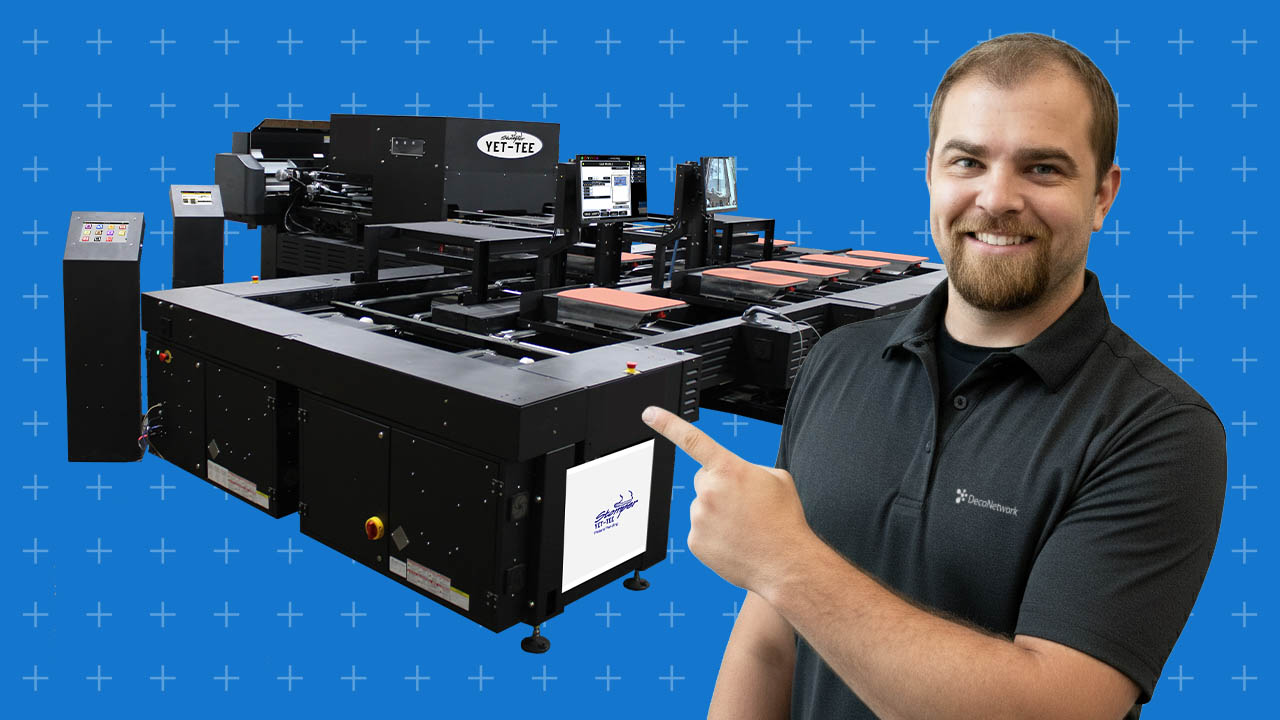
That is where the Yet-Tee Automatic DTF Press from Brown Manufacturing comes in. Built for single operator production, the Yet-Tee connects transfer cutting, powdering, curing, placement, peeling, and finishing into one automated workflow. It is designed for real world jobs where every garment can be different, from names and sizes to artwork and placement.
When you pair automation like this with DecoNetwork, the impact goes beyond the press. Orders, artwork details, and production scheduling can stay organized in one system, so the shop can move faster, reduce errors, and scale DTF output without chaos.
What Is the Yet-Tee Automatic DTF Press?
The Yet-Tee is an automatic DTF press system from Brown Manufacturing designed to help print shops produce completed, ready to ship DTF garments with a single operator. Instead of treating DTF as a series of disconnected stations, the Yet-Tee combines the key steps into one controlled production line that returns the finished garment to the operator, ready to package.
The system is built around a simple production flow. Load the garment, scan the barcode, and the Yet-Tee handles the rest. It pulls transfers directly from a connected DTF printer, cuts them to reduce film waste, powders and shakes off excess adhesive, cures the transfer using the patented FireFly curing unit, then places the transfer on the garment using the Flipper placement system. Optional automation can peel the carrier sheet and support post pressing for a completed finish.
What makes this especially relevant for the DTF printing industry is its focus on decorating on demand. Shops are not always printing 100 of the same design. Many are producing high mix jobs where every shirt can be unique in artwork, placement, and cure. The Yet-Tee is designed for that reality, offering repeatability, efficiency, and a workflow that scales without adding more hands to the line.
How the Yet-Tee Automates the DTF Workflow
The biggest bottleneck in many DTF shops is not printing the transfer. It is everything that happens after the print comes out. Powdering, curing, lining up placement, pressing, peeling, and post pressing often require multiple stations and multiple touch points. The Yet-Tee is built to connect those steps into one automated path so one operator can keep production moving.
It starts with job identification. The operator loads a garment and scans a barcode tied to the artwork. That scan triggers the transfer to be printed on roll film, then the system pulls the printed transfer forward and cuts it to the exact length needed, helping reduce film waste.
Next, the transfer moves into the powder unit with a shaker that applies adhesive and removes excess. From there it enters the patented FireFly curing unit, which is designed to bring the adhesive into the correct temperature range for consistent bonding.
After curing, the patent pending Flipper placement system flips and positions the transfer on the garment in the desired print location. The system uses software defined placement, then a set press holds the transfer in place while the adhesive is still warm. That set step prevents shifting as the garment moves into final finishing. With the optional Stomper Peel system, the carrier sheet can be removed automatically, followed by post pressing to complete the transfer application.
The result is a workflow that is easier to repeat, easier to train, and far more practical for decorating on demand where every garment can be different.
Production Speed, Film Savings, and What It Means for DTF Shops
DTF is profitable when the workflow is smooth. When it is not, the extra steps eat your time, your film, and your labor. The Yet-Tee is designed to solve those pressure points by keeping the printer busy, reducing wasted material, and letting one operator run the full line without juggling multiple stations.
Production Speed, Film Savings, and What It Means for DTF Shops
Brown Manufacturing positions the Yet-Tee for decorating on demand, where every garment can be different. In that environment, the system is designed to produce roughly 80 to 120 unique garments per hour with a single printer setup because printing and garment handling happen at the same time. The printer can keep printing as transfers are being processed and garments are moving through placement and finishing.
For higher volume operations, the system can expand to multiple printers, with a stated range of 250 to 325 units per hour in a wider configuration. That matters for shops that want to grow DTF capacity without rebuilding the entire process from scratch.
Film efficiency that protects margins
Film is one of the most expensive consumables in DTF. The Yet-Tee tackles this by using a cutter to pull exact cut transfers from the roll. That means you are not forced into wasting extra film length to keep jobs aligned. It also encourages shops to choose roll width based on what they actually print most often, rather than paying for wide film that rarely gets used.
Less handling and fewer chances to mess up
Every time a transfer is handled, there is a chance for misalignment, contamination, or errors in placement. By combining powdering, curing, placement, and optional peel into a single automated flow, the Yet-Tee reduces touch points and makes repeatability easier. For DTF shops running a mix of sizes, colors, names, and one off designs, that consistency can be the difference between scaling profitably and constantly reworking jobs.
The Takeaway: Yet-Tee Automatic DTF Press
The Yet-Tee Automatic DTF Press is built for the way most print shops actually produce today: fast turnaround, high mix orders, and constant customization. By combining cutting, powdering, curing, placement, and optional peeling into one connected workflow, it turns DTF into a more repeatable process that a single operator can run with fewer touch points and fewer bottlenecks.
For DTF printing businesses, the biggest value is control. Exact cut transfers help reduce film waste. Automated powder and cure steps improve consistency. Software defined placement and the Flipper system help keep alignment predictable, even when every garment is different. That makes the Yet-Tee especially relevant for decorating on demand, where speed only matters if quality stays consistent.
If your shop is looking to scale DTF without scaling chaos, the takeaway is simple. Systems like the Yet-Tee are not just about automation. They are about building a production lane that stays efficient as your order volume and customization demands grow.