At DecoNetwork, we know automation is reshaping the garment decoration industry, especially as DTF demand pushes shops to produce more with fewer hands. Traditional heat presses can still get the job done, but their limitations become obvious as volumes grow. The ROQ Impress was built to solve that problem, offering a fully automated, high-speed workflow that reduces labor, increases consistency, and delivers real production gains. Here’s how it compares to traditional presses.
What The ROQ Impress Automates That Traditional Presses Don’t
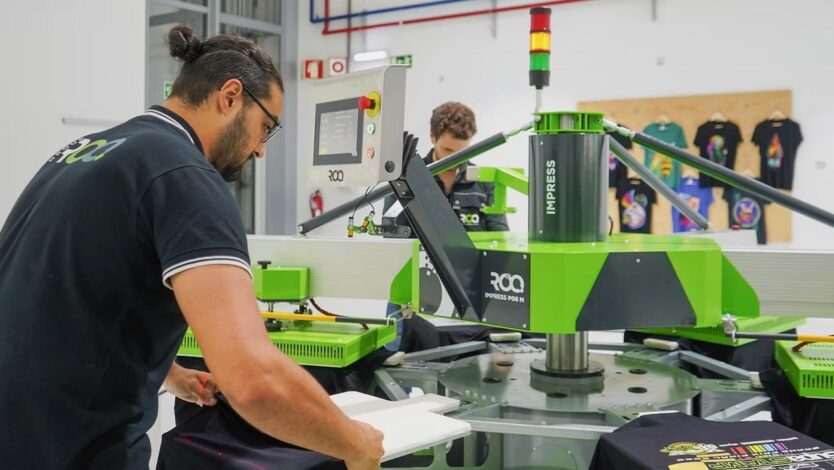
The ROQ Impress removes the manual steps that slow down traditional heat presses. Instead of relying on multiple operators to load, place transfers, press, peel, and unload garments, the Impress automates the entire cycle. Its multi-zone heating, precision transfer placement, auto-peel system, and automatic stacking create a consistent, repeatable workflow. Traditional shuttle or clamshell presses depend on human timing and accuracy, which leads to variation and bottlenecks as production scales. With the Impress, one operator can manage output that previously required three or more people, all while maintaining identical placement and peel timing across every garment.
Labor, Speed, And ROI Comparison
Traditional heat presses depend heavily on labor, often requiring multiple operators to load garments, place transfers, press, peel, and unload. This limits output and drives up costs as production scales. The ROQ Impress changes the equation by allowing a single operator to produce 400 to 500 pieces per hour through fully automated transfer placement and peeling. That speed, paired with reduced staffing, creates a measurable ROI. Instead of paying multiple employees to manage repetitive tasks, shops gain consistent, predictable production from automation that never slows down. Over time, lower labor costs and higher daily output make the Impress far more cost-effective than manual or shuttle-based setups.
Versatility, Scalability, And Real-Shop Applications
The ROQ Impress was built for shops that need flexible, high-volume production. It handles hoodies, bags, and difficult placements that slow down traditional heat presses, and its carousel design keeps garments moving even on complex jobs. Because the workflow is automated, shops can scale output without adding more staff or juggling multiple shuttle stations. The Impress also integrates easily with conveyors and downstream equipment, opening the door to folding and bagging automation. Smaller shops with low daily volume may not need this level of speed, but growing print shops and DTF fulfillment operations gain a scalable system that supports long runs, consistent quality, and faster turnaround times.
ROQ Impress vs. Traditional Heat Presses
The ROQ Impress delivers automation that traditional heat presses simply cannot match, offering higher output, fewer operators, and more consistent results. While manual and shuttle presses still work for low-volume shops, growing decorators benefit from the Impress’ speed and reliability. For print shops looking to scale, reduce labor costs, and improve production flow, the ROQ Impress stands out as a smart, future-ready upgrade.