PPAI Expo 2026 makes one thing clear fast: the biggest opportunity in branded merchandise is not buying more equipment. It’s learning how the industry’s fastest-growing sellers scale by acting like a one-stop solutions provider, even when they outsource production.
Walking the show floor, the pattern is obvious. Distributors win with relationships, product knowledge, and speed, while contract decorators power the fulfillment behind the scenes. Customers do not care who physically decorated the item. They care that it looks right, shows up on time, and makes their brand look good.
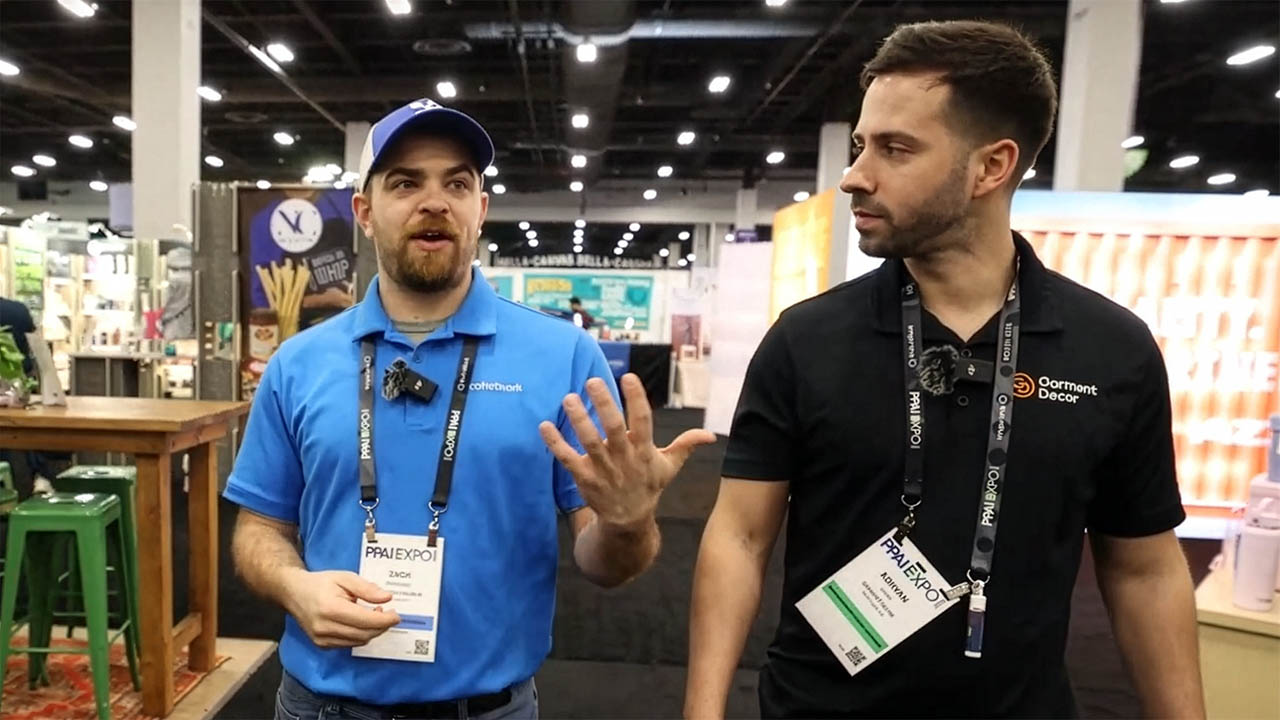
In this Part 1 walkthrough, you’ll hear Zach Dewhurst of DecoNetwork and Adryan Lado of Garment Decor break down the core insights and trends that matter most right now: what products are gaining attention, why drinkware and apparel stay dominant, and why outsourcing is the simplest way to offer more without taking on more risk.
Biggest Trend At PPAI Expo 2026: Outsourcing Is The Growth Model
The show floor message is blunt: the smartest growth move is not buying more equipment. It’s building a sales engine that can deliver more products by outsourcing production and staying lean. In the walkthrough, distributors are framed as “marketers” who avoid the in-house rabbit hole because outsourcing keeps overhead low and removes the constant stress of space, payroll, and capacity limits.
The real unlock is understanding what “one-stop solutions provider” actually means. It doesn’t mean you decorate everything yourself. It means you know how to sell the right product, manage the order, and deliver a professional result using the right partners. Outsource, outsource, outsource, and grow by becoming the hub that connects the job to the right decorator or supplier.
That’s why contract decorators are the backbone of this model. When a job does not fit your workflow, your equipment, or your schedule, the play is simple: outsource it to a partner that can execute it cleanly. The walkthrough calls out that contract decorators make life easier when something “doesn’t make sense” to do in-house, or when you don’t have the equipment for it.
Distributors vs Decorators: Two Models, Two Advantages
PPAI Expo 2026 makes the split easy to understand. Distributors are sales reps who build relationships locally, then lean on partners to fulfill the work. Contract decorators win because that distributor network becomes national distribution for their services.
The key difference is what each side optimizes for. Decorators are forced to prioritize speed of service, turnaround, and production execution. Distributors prioritize depth of relationship, becoming more “intimate” with the client and supporting them across more product categories over time.
This is why the distributor model for promotional products is growing. You can sell branded merchandise, outsource the decoration, and stay focused on service and solutions. Customers often know you didn’t decorate it, and they do not care. What they care about is timing, accuracy, and that the final product matches the mockup.
Makers vs Marketers: The Mindset Shift Driving Growth In 2026
One of the strongest takeaways from PPAI Expo 2026 is that the winners are not trying to be the best “maker” in the room. They’re trying to be the best marketer and relationship builder. The walkthrough frames it as a simple split: decorators often think like builders and craftspeople, while distributors think like sellers who package solutions and move fast.
That mindset shift is why outsourcing keeps coming up. When you operate like a marketer, you do not need to own every machine to sell more categories. You need reliable partners, clean processes, and the ability to deliver what the client wants without adding risk to your business. The distributor model of “minimal risk” with “high upside” allows you to scale without investing in production capacity.
This is where many print shops get stuck. They assume growth means expanding production first. But the show floor takeaway is the opposite: grow your offer, expand your product range, and let fulfillment happen through contract decorators and suppliers while you focus on sales, brand guidance, and repeat orders.
Customers Don’t Care Who Decorates It (They Care That It’s Right)
One of the most useful truths from the PPAI Expo 2026 walkthrough is also the simplest: your customer does not care who actually produced the item. Customers often know you didn’t do the decorating, and they don’t care, because they’re buying the finished result, not the behind-the-scenes process.
What they do care about is reliability. The walkthrough explains it plainly: it needs to arrive on time and look like the mockup. That’s the standard you’re really being judged on, whether the item is apparel or a hard good.
This is why the “one-stop solutions provider” model keeps winning. You can outsource a pen, a hat, or an apparel order and still deliver a premium experience as long as you manage the process and protect the client’s brand. The value isn’t the decorating step. It’s the total experience you create from order to delivery.
The Real Trend: Be The Brand Expert, Not The Vendor
The strongest “sell better” insight from the PPAI Expo 2026 walkthrough is this: stop thinking like a shop that just fills orders, and start thinking like an extension of your client’s brand. Talk to the client, help them build brand awareness and unity, and treat branded merchandise like a real marketing tool, not a side add-on.
This is also where promotional products stop being “trinkets and trash” and start becoming high-value tools for recognition, culture, and retention. You’re not just selling items. You’re guiding a customer through what to put their logo on, and why it matters.
When you become familiar with a customer’s brand, your product range expands instantly. The walkthrough explains it plainly: companies want someone who “gets their brand,” and once you do, there’s a world of products you can apply that logo to. That’s the real distributor advantage in 2026.
Relationship Building Beats “Just E-Commerce” For Repeat Orders
One of the clearest lessons from the PPAI Expo 2026 walkthrough is that this industry still runs on relationships, not browsing carts. The distributor advantage is simple: they stay close to the customer and build trust over time, which makes repeat orders easier and upsells natural.
That closeness is what creates long-term accounts. The relationship gets so strong that the customer already knows the distributor isn’t doing the decorating, and they don’t care. The distributor is managing the details, protecting the brand, and making sure the client gets the right result.
This is why “one-stop solutions provider” keeps winning in 2026. The distributor isn’t trying to be the factory. They’re acting like an extension of the client’s marketing team, guiding product choices and handling the process end-to-end.
Wholesale + Contract Decorators + Drop Shipping
The business model powering a lot of what you’re seeing at PPAI Expo 2026 is surprisingly simple: sell the job, then fulfill it through a network. Distributors build the relationship and close the order. Contract decorators handle production. Wholesale suppliers and drop shipping keep the logistics clean.
This stack works because it removes the biggest growth bottleneck for most decorators: capacity. When a job doesn’t fit your workflow, your equipment, or your schedule, the walkthrough frames the move as practical, not emotional. You outsource the decoration to someone built for it and keep the customer experience under your control.
The takeaway is that scaling in 2026 looks less like “own everything” and more like “coordinate everything.” The seller who wins is the one who can reliably deliver the right product, at the right quality, on the right timeline, even if none of it was made in-house.
How To Apply These PPAI Expo 2026 Insights
Start by narrowing your offer to a few categories you can sell confidently and repeat. Apparel stays the foundation, and drinkware is the easiest upsell because it fits almost every corporate order. The goal is not to sell everything. It’s to sell a small set of products that you can deliver consistently.
Next, build a simple outsourcing bench. Outsourcing is what makes growth low-risk. When a job doesn’t make sense to produce in-house, or you don’t have the equipment for it, send it to a contract decorator who does. You stay focused on the customer and protect the quality of the final result.
Finally, sell like a brand partner, not a vendor. Customers don’t care who decorated the product, they care that it looks right and shows up on time. If you can guide product choices, manage the process end-to-end, and deliver a clean result, you become the person they rely on for every future order.
The Takeaway From PPAI Expo 2026
PPAI Expo 2026 proves that the fastest way to grow in branded merchandise is not doing more in-house. It’s selling like a one-stop solutions provider and outsourcing what you do not need to own. The distributors winning in 2026 are the ones who build relationships, guide product decisions, and deliver the right result on time, every time. Customers do not care who decorated it. They care that it looks right, matches the proof, and makes their brand look good.