
Add DecoNetwork as a preferred source for industry insights.
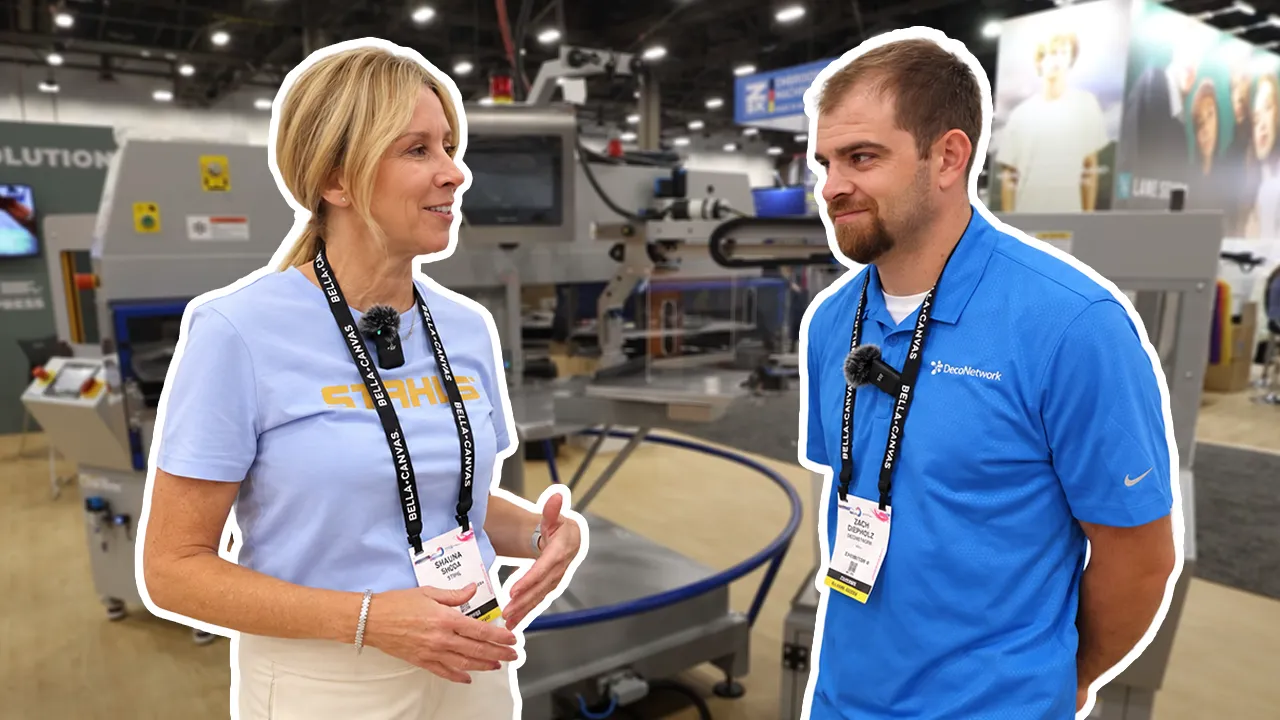
STAHLS has introduced a new Hotronix Carousel Heat Press capable of producing up to 300 shirts per hour with one operator. Unveiled at PRINTING United Expo 2026 in Las Vegas, the automated system is designed to help garment decorators increase production while reducing repetitive manual work.
The new STAHLS Carousel Heat Press combines automated transfer placement, multiple heating stations, and optional automatic peeling in one rotating system.
How The New Hotronix Carousel Heat Press Works
The Hotronix Carousel Heat Press features six rotating stations and three independently controlled heating zones. Garments move through pre-pressing when needed, automated transfer placement, and two heat applications before the carrier is peeled away manually or automatically.
With multiple stations operating simultaneously, the carousel keeps production moving while one operator loads and unloads garments.
The carousel works with several heat transfer products, including DTF transfers, Goof Proof screen print transfers, and compatible patches.
Automated placement requires consistently sized transfers with suitable, non-tacky carriers. Interchangeable platens also accommodate different garment applications, while the optional automatic peeler can reduce manual handling.
Up To 300 Shirts Per Hour With One Operator
STAHLS rates its new carousel heat press at up to 300 garments per hour with one operator.
While one garment is being loaded, others move through transfer placement and pressing. This continuous workflow reduces the manual steps typically required with traditional single-station heat presses.
For a contract decorator producing hundreds of matching company T-shirts, the carousel can handle transfer placement and pressing while the operator concentrates on loading garments.
For shops handling repeat orders, automated transfer placement can reduce manual positioning on each garment and help maintain consistency throughout larger production runs.
Actual output will depend on garment types, transfer applications, and production setup.
What Print Shops Should Know Before Investing
The STAHLS Carousel Heat Press is designed primarily for high-volume garment decorators, contract printers, and fulfillment operations handling repeatable heat transfer jobs.
A price of approximately $79,990 for the carousel and transfer placer was quoted during a demonstration at PRINTING United Expo 2026. Buyers should contact STAHLS for current pricing. An automatic peeler is available as an optional upgrade.
The equipment also requires three-phase electrical power, a suitable compressed-air system, and adequate floor space. Exact installation requirements should be confirmed with STAHLS.
Shops also need a reliable supply of prepared transfers to prevent material shortages from interrupting production.
Before investing, decorators should consider their weekly production volume, labor costs, and how frequently the carousel would operate. Shops handling consistent, high-volume orders are more likely to benefit than those producing short runs with frequent design changes.
The important question is whether reduced labor time and increased output justify the equipment costs.
What Automated Heat Pressing Means For Print Shops
The new STAHLS Carousel Heat Press shows how automation can help decorators handle larger production volumes with less manual work. But producing 300 shirts per hour also means keeping up with customer orders, artwork approvals, and production schedules.
That’s where DecoNetwork fits in. By bringing quotes, orders, artwork, and production management into one platform, DecoNetwork helps print shops keep work organized as production capacity increases.
Together, efficient equipment and organized workflows can help decorators take on more orders without creating unnecessary bottlenecks.