Picture this: your DTF printer stops halfway through a 500-shirt order that must ship tomorrow. The printer saved you thousands upfront, but the technician is in another time zone, the replacement part is overseas, and your customer does not care why production stopped.
Would the more expensive machine suddenly look like the better deal?
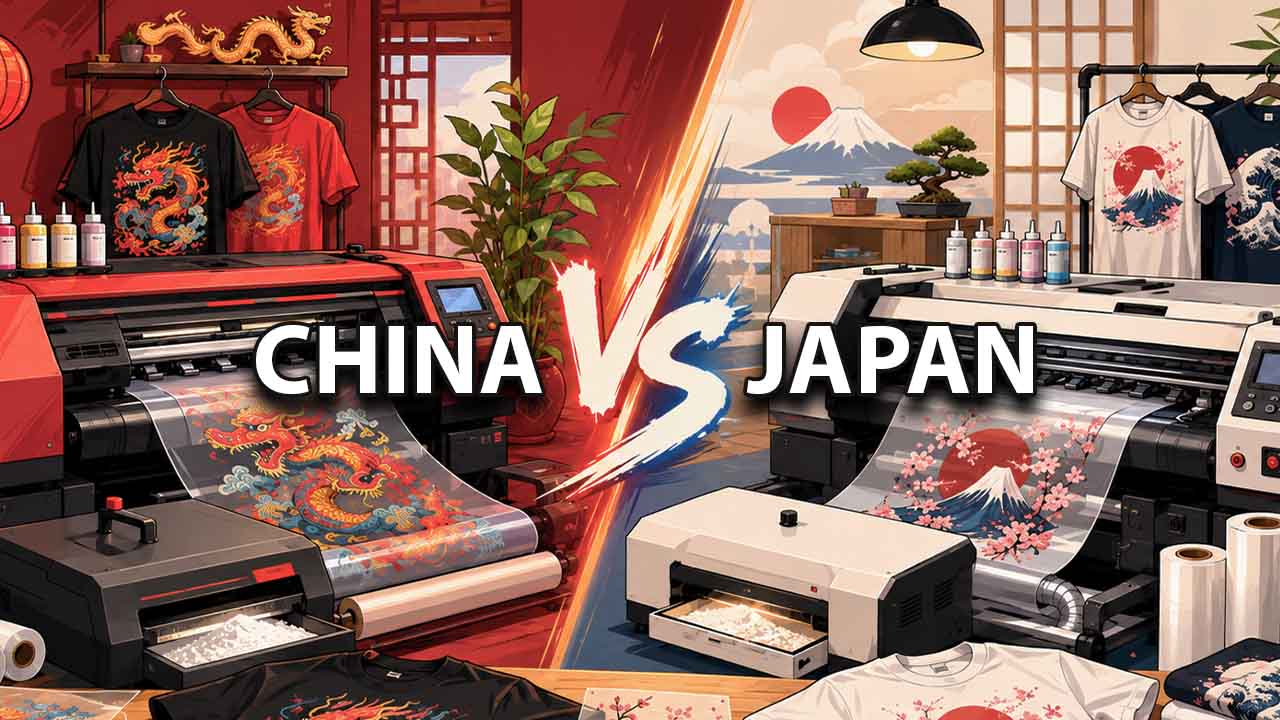
That question is at the center of the DTF printer war between China and Japan.
Chinese DTF printers generally compete through lower entry costs, more configurations, open consumable choices, and aggressive production capacity. Japanese DTF printers generally compete through integrated maintenance, controlled workflows, manufacturer support, and predictable operation.
Neither side automatically produces the best DTF printer for every business. The winner depends on your budget, technical knowledge, production volume, tolerance for downtime, and total cost of ownership.
DTF Printer War: The Quick Verdict
- China wins on equipment choice, customization, and production capacity per dollar.
- Japan wins on integrated workflows, automated maintenance, and standardized support.
- Your shop wins when the printer matches its skills, workload, and appetite for risk.
Here is how the two sides compare.

Round 1: Price and Equipment Choice
Need a compact desktop printer, a 24-inch roll system, fluorescent ink, four printheads, or an industrial production line?
The Chinese DTF printer market probably offers a configuration for it.
Chinese manufacturers helped make direct-to-film printing accessible to businesses at nearly every stage. Their equipment ranges from small systems for home-based startups to commercial machines equipped with multiple Epson i3200 printheads.
That range gives print shops more ways to enter and scale DTF production. A business can begin with a smaller machine, learn the workflow, and upgrade as its transfer volume grows.
Chinese DTF printers may also provide more freedom to choose:
- RIP software
- DTF ink
- Transfer film
- Adhesive powder
- Powder shakers and dryers
- Printhead configurations
- Replacement components
- Specialty colors and fluorescent inks
That flexibility can be valuable to an experienced operator. A technically capable shop may prefer to control its ink costs, experiment with different films, build custom color profiles, and keep replacement parts on-site.
Japanese manufacturers make a different bet: a print shop may accept fewer configurations in exchange for fewer production variables.
Epson, Mimaki, and Roland DG offer purpose-built DTF systems designed around specific inks, software, maintenance procedures, and support networks. Their equipment ranges have expanded, but they remain more controlled than the broad Chinese OEM market.
Epson entered dedicated wide-format DTFilm printing with the 35.4-inch SureColor G6070. Mimaki offers multiple TxF models, including its wider 63-inch TxF300-1600. Roland DG covers both compact and commercial production with machines such as the VersaSTUDIO BY-20 and TY-300i.
Round 1 Winner: China DTF Printers
China wins the first round through variety.
A buyer can choose from more widths, more printhead arrangements, more consumable options, and more price levels. Japan offers credible choices, but China remains difficult to beat when customization is the priority.
However, more choice also creates more opportunities to choose the wrong combination.

Round 2: Speed and Production Capacity
Chinese DTF manufacturers are not shy about adding printheads.
Commercial machines may use two, four, six, or even eight Epson i3200 printheads. More heads can increase output, separate color and white channels, or support specialty ink configurations. Manufacturers such as Hanrun offer systems that range from compact dual-head machines to wide production models with six or eight heads.
For a dedicated DTF transfer producer, that capacity can be attractive. More output may mean:
- Shorter turnaround times
- More gang sheets per shift
- Greater wholesale transfer capacity
- More room to accept contract work
- Less pressure during seasonal demand
But advertised DTF printer speed can be misleading.
A speed figure means little unless the buyer knows the print resolution, pass mode, white-ink coverage, artwork density, film width, and curing conditions used during the test.
A machine printing a light design in a fast four-pass mode should not be compared directly with another printing a dense image at a higher quality setting.
More printheads can also introduce more complexity. They may require additional alignment, maintenance, ink management, and replacement costs. A six-head machine is not automatically more profitable than a stable two-head machine.
Japanese manufacturers increasingly compete with production-focused equipment rather than relying on reliability alone.
Mimaki’s wider TxF300-1600 supports 63-inch media, while Roland DG positions the TY-300i for commercial CMYK and white production. Epson’s dedicated DTF platform also targets decorators that need wider output and reduced operator intervention.
The result is a closer contest than it once was.
China still offers more aggressive multihead configurations. Japan is responding with machines designed to maintain speed without placing as much daily responsibility on the operator.
Round 2 Winner: China DTF Printers (With Conditions)
China wins on maximum configuration choice and potential output.
The condition is important: production speed only creates value when the printer, ink system, film feeding, powdering, curing, and operator can sustain it.
A printer that runs quickly for a demonstration but inconsistently during an eight-hour shift is not a high-production machine.

Round 3: Reliability and Maintenance
This is where the battle changes.
White ink is one of the biggest challenges in DTF printing. The pigment can settle, nozzles can clog, and neglected maintenance can quickly turn into lost production.
Chinese DTF printers can be reliable, but reliability varies widely between manufacturers, distributors, and machine configurations.
One supplier may deliver a properly configured production line with installation, training, tested consumables, color profiles, spare parts, and responsive domestic support. Another may ship a similar-looking machine with basic instructions and remote help from another time zone.
The words “Chinese DTF printer” therefore describe a huge category rather than a consistent ownership experience.
Japanese manufacturers generally focus on reducing the number of maintenance decisions an operator must make.
Epson’s SureColor G6070 includes automated maintenance, nozzle-verification technology, sealed ink packs, and on-site service under its limited warranty. Mimaki’s TxF platform addresses white-ink sedimentation and ink-ejection problems through circulation and nozzle-management technology. Roland DG combines its DTF hardware with automated maintenance, monitoring tools, software, warranty coverage, and technical support.
These features do not make a Japanese DTF printer maintenance-free.
Operators must still control room conditions, follow cleaning schedules, manage consumables, inspect nozzles, and maintain the powdering and curing equipment. White ink does not stop being white ink because the logo on the printer changes.
The difference is that Japanese systems tend to place more of the workflow under one manufacturer’s control.
Round 3 Winner: Japan DTF Printers
Japan wins the reliability and maintenance round because its manufacturers generally sell a more controlled operating experience.
A well-supported Chinese printer can still be dependable. The difference is that buyers may need to investigate the machine, distributor, consumables, service process, and spare-parts supply more carefully.

Round 4: The Japanese Technology Hidden Inside Chinese DTF Printers
Here is where the China-versus-Japan story becomes more complicated:
The Chinese DTF printer you are considering may already contain Japanese technology.
Many Chinese-built DTF machines use Epson printheads. The Epson i3200 is especially common in commercial configurations, while other systems may use Epson i1600 or XP600 printheads.
This creates a global machine rather than a purely Chinese one.
A printer may combine:
- A Chinese frame and ink system
- Japanese Epson printheads
- Third-party RIP software
- Imported motion components
- Film and powder from another supplier
- Local installation and technical support
That raises an important buying question.
Does an Epson i3200 Printhead Make a Chinese DTF Printer an Equivalent?
No.
The printhead is one important component, but it does not define the complete printer.
Two DTF printers using the same Epson printhead can perform differently because of their:
- Carriage stability
- Printhead alignment
- Mainboard design
- Waveform tuning
- Ink pressure
- White-ink circulation
- Dampers and capping station
- Cleaning system
- Film feeding
- Take-up system
- Heating and curing
- RIP software
- ICC profiles
- Ink formulation
- Firmware
- Environmental controls
Think of the printhead as the engine. The engine matters, but so do the transmission, cooling system, electronics, chassis, service network, and driver.
A high-quality printhead inside a poorly integrated system will not guarantee high-quality production.
Myth vs Reality
Myth: More printheads always mean a better DTF printer.
Reality: More printheads may increase speed, but they can also increase alignment work, maintenance points, and replacement expenses.
Myth: A Japanese printhead makes every printer equally reliable.
Reality: Ink delivery, electronics, maintenance design, software, curing, and support all influence reliability.
Myth: Every Chinese printer is difficult to support.
Reality: Established manufacturers and domestic distributors may provide training, stocked parts, installation, and strong service. Buyers must verify what is included.
Round 4 Winner: No One
This round exposes the flaw in treating DTF printing as a simple national rivalry.
China and Japan are often part of the same supply chain. The meaningful comparison is not just where the printer was assembled. It is how well every component has been integrated and supported.

Round 5: Support, Total Cost, And The Right Printer For Your Shop
Alex and Maria are both shopping for a commercial DTF printer.
Alex owns a growing startup. He understands inkjet equipment, enjoys solving technical problems, and is comfortable keeping dampers, pumps, caps, and cleaning supplies in stock. His budget is limited, but he wants as much production capacity as possible.
A supported Chinese DTF printer may be the right move for Alex.
Maria runs an established decoration company with employees, recurring school orders, and strict event deadlines. She does not want her production manager spending half a day troubleshooting a printer. Fast service and predictable operation matter more than finding the lowest equipment price.
A Japanese DTF printer may be the better investment for Maria.
Neither owner is wrong. They are buying for different businesses.
Which Type of DTF Buyer Are You?
A Chinese DTF printer may suit your shop when you value:
- A lower barrier to entry
- More equipment configurations
- Open consumable choices
- In-house technical control
- High potential output per dollar
- The freedom to modify the workflow
- Access to a trusted distributor with stocked parts
A Japanese DTF printer may suit your shop when you value:
- Automated maintenance
- Manufacturer-controlled inks and software
- Documented operating procedures
- Local dealer installation
- Standardized technical support
- More predictable color and output
- Reduced operational uncertainty
Do Not Confuse Purchase Price With Ownership Cost
The price on the quotation is only the beginning.
Calculate the complete DTF printer total cost of ownership:
Purchase price
- powder shaker and curing unit
- RIP software
- ink, film, and powder
- cleaning supplies
- replacement parts
- printhead replacement
- operator labor
- service and maintenance
- wasted transfers
- outsourced production
- downtime
- financing
− estimated resale value
Compare these costs over 12, 24, and 36 months.
Saving thousands on the machine may not be a saving if three breakdowns lead to emergency shipping, outsourced transfers, overtime, and lost customers.
The opposite is also true. Paying a premium for a tightly controlled system may not generate a better return when the shop has the expertise to maintain a more open machine efficiently.
Questions to Ask Before Buying Any DTF Printer
Do not leave the demonstration until these questions have clear answers:
- What speed can the printer sustain in the production mode I will actually use?
- Does that speed include the white-ink layer?
- Can I provide my own artwork for a live demonstration?
- Who installs and profiles the printer?
- Which RIP software is included?
- Which parts are excluded from the warranty?
- Is the printhead covered?
- Are replacement parts stocked in my country?
- What is the normal technical-support response time?
- Which inks, films, and powders have been tested together?
- What maintenance is required every day and every week?
- What happens if the machine is down for three days?
- Can I speak with an existing customer running a similar workload?
- Can I inspect printed, pressed, stretched, and washed samples?
A supplier’s answers may tell you more than its specification sheet.
Round 5 Winner: A China Japan Tie
China can win this round when the machine comes from a knowledgeable distributor that offers training, parts, profiling, and responsive service.
Japan can win when manufacturer-backed support and automated operation prevent enough downtime to justify the higher investment.
The printer’s country matters less than the people, parts, and processes standing behind it.
Takeaway: The Best DTF Printer Still Needs The Right Workflow
China may win on equipment choice, customization, and production capacity per dollar. Japan may win on integrated maintenance, standardized support, and predictable operation. However, the printer is only one part of building a profitable DTF business.
No matter which machine you choose, your shop still needs to manage quotes, orders, artwork approvals, production schedules, customer updates, payments, and online sales.
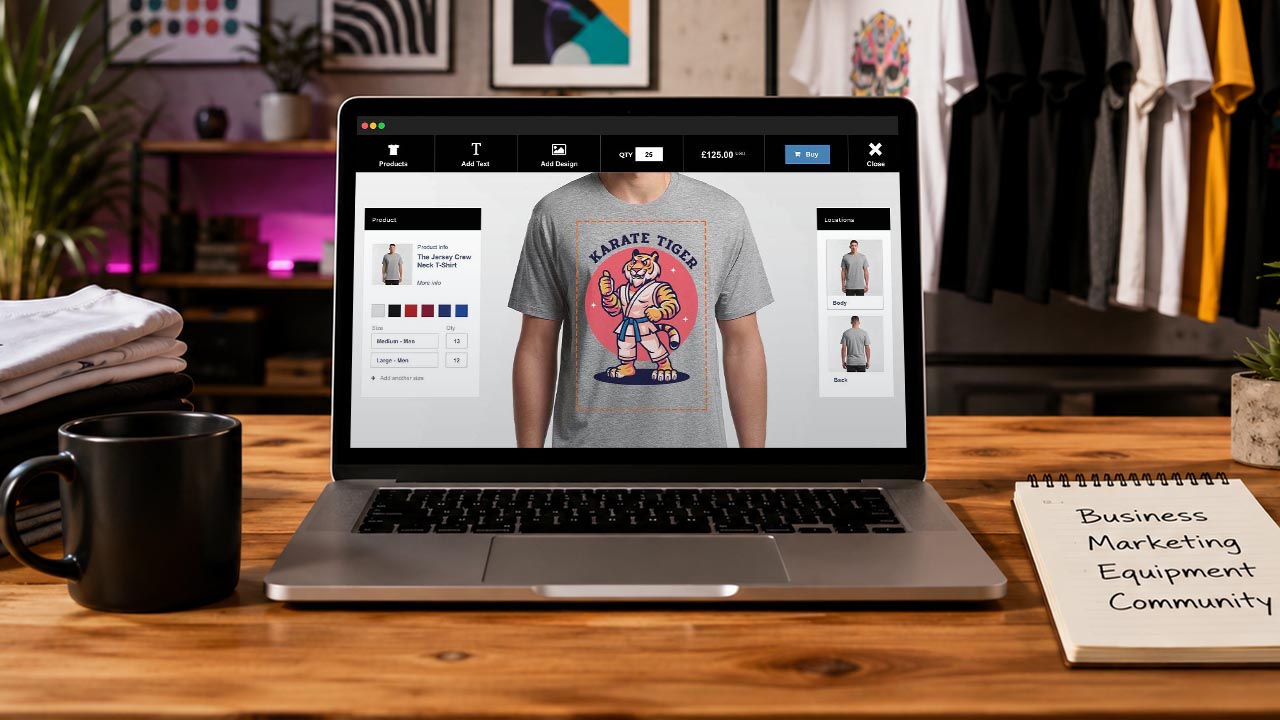
DecoNetwork is an all-in-one business management and e-commerce platform built for custom apparel decorators. It helps DTF printing businesses move orders from the first quote through production and delivery without relying on disconnected spreadsheets, inboxes, and manual processes. Shops can manage customer orders, artwork approvals, production tasks, online stores, purchasing, and payments from one connected system.
DecoNetwork does not replace your printer’s RIP software or maintenance tools. Instead, it connects the business workflow around your equipment. Whether your shop invests in a flexible Chinese DTF printer or a more controlled Japanese system, DecoNetwork helps keep the work organized, visible, and ready for production.
The real winner of the DTF printer war is not simply China or Japan. It is the print shop that combines the right equipment with a workflow that protects margins, reduces manual work, and helps every order move forward on time.