
Add DecoNetwork as a preferred source for industry insights.
Four automatic presses are only the beginning at Super Screen Printing and Embroidery in Phoenix, Arizona.
Around 95% of the business is contract decorating, with screen printing, embroidery and digitizing handled in-house. Quality and communication also rank ahead of simply competing on price.
This print shop tour shows how Super combines equipment, trained people and repeatable processes to keep a high-volume operation moving.
Inside The Screen Printing Department: Four Automatic Presses In Action
The first stop is the screen printing department, where four M&R automatic presses regularly run production.
Around 14 to 15 employees work in the department, with team members cross-trained across screen burning, reclaiming, loading, catching and basic printing.
That flexibility helps when someone is absent. Employees can step into other production tasks instead of having one part of the workflow depend entirely on one person. It also gives the team opportunities to learn more than one job.
Super takes a similarly careful approach to capacity. The company does not automatically accept every potential contract account. New customers need to fit the shop’s ability to maintain the service existing customers already expect.
Four presses create production capacity. A flexible team helps make that capacity dependable.
Inside The Embroidery Department: About 80 Heads And In-House Digitizing
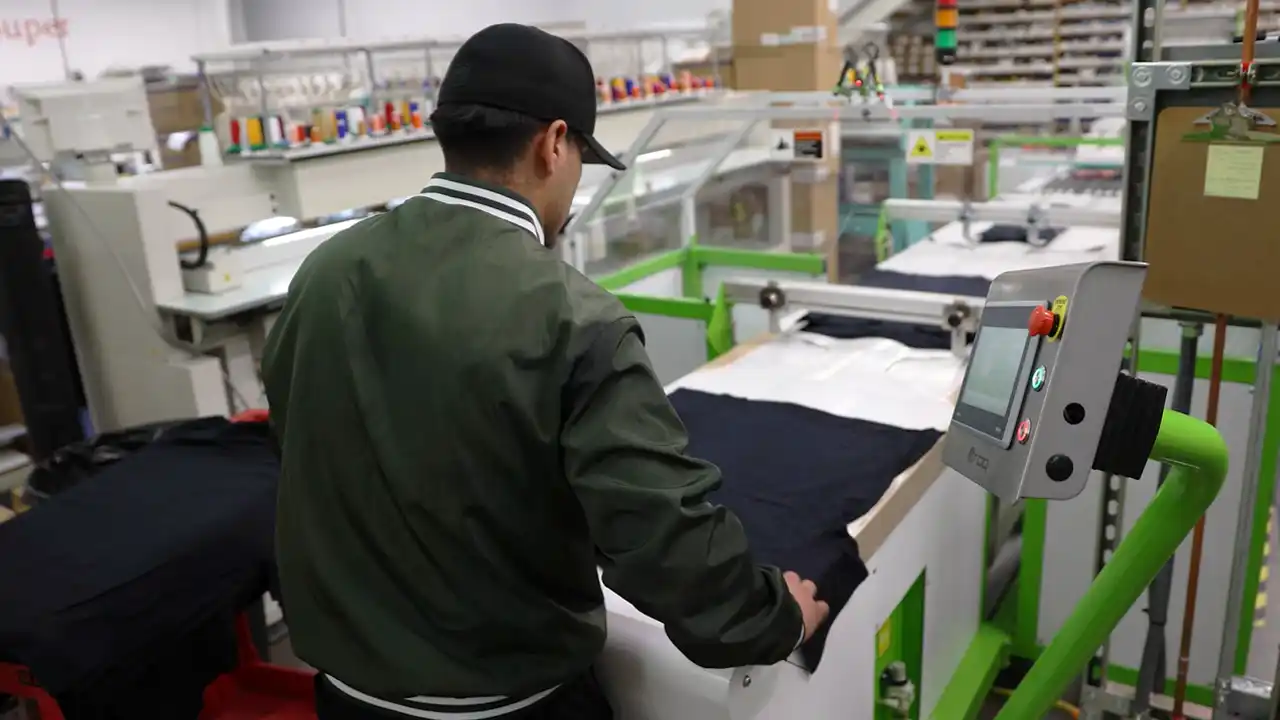
From screen printing, the tour moves into an embroidery department with about 80 heads.
Some machines are normally dedicated to hats while others handle flats. Operators are trained to run both when production demands change.
Quality control starts before the full run.
Every new embroidery order receives a test sew, and repeat orders may be tested again when the garment changes. The embroidery manager reviews the sew-out before production continues, while smaller machines can handle new-order samples without slowing the main floor.
Digitizing is also handled in-house using Wilcom. If a file needs a minor adjustment, the team can make the change, run another sew-out and keep the job moving.
Super’s process also shows why embroidery quality depends on more than the machine. Digitizing, thread weight, needle size and backing all affect how cleanly a design runs and finishes.
At this volume, catching a problem before production begins can prevent a much larger problem later.
Inside The Finishing Department: How Super Increased Daily Output
The final stop shows what happens after decoration is finished.
Super previously handled folding, bagging, heat sealing and labelling through several manual steps. Mike explains that the process could involve around seven people. After adding automated finishing equipment, roughly two or three people can handle the same workflow.
On a good day, Super can process around 3,000 folded, bagged, heat-sealed and labelled pieces, compared with roughly 1,200 before the change.
That improvement also frees employees to work on other orders that need cleaning, boxing or shipping. The result is more work moving through the shop instead of waiting behind a finishing bottleneck.
The same principle applies before production starts. Super places value on receiving artwork, purchase orders, tracking details and other job information as completely as possible so the team spends less time chasing missing details.
That is also where print shop management software can help. DecoNetwork brings quoting, orders, artwork, online stores, and production management into one platform, giving decorators fewer systems to manage as order volume grows.
What Others Can Learn From Super Screen Printing and Embroidery
The four automatic presses and roughly 80 embroidery heads show the scale of Super Screen Printing and Embroidery. The more useful lesson is how the operation supports that scale.
Cross-training keeps production flexible. Test sew-outs protect embroidery quality. Better finishing equipment removes a bottleneck. Complete job information reduces unnecessary back-and-forth.
That is what stands out most from this shop tour. Super has built each part of the operation to support the next, helping quality work move from order information through production and out the door.